How Much Does a Custom Web App Cost in 2027? Price Ranges by Feature
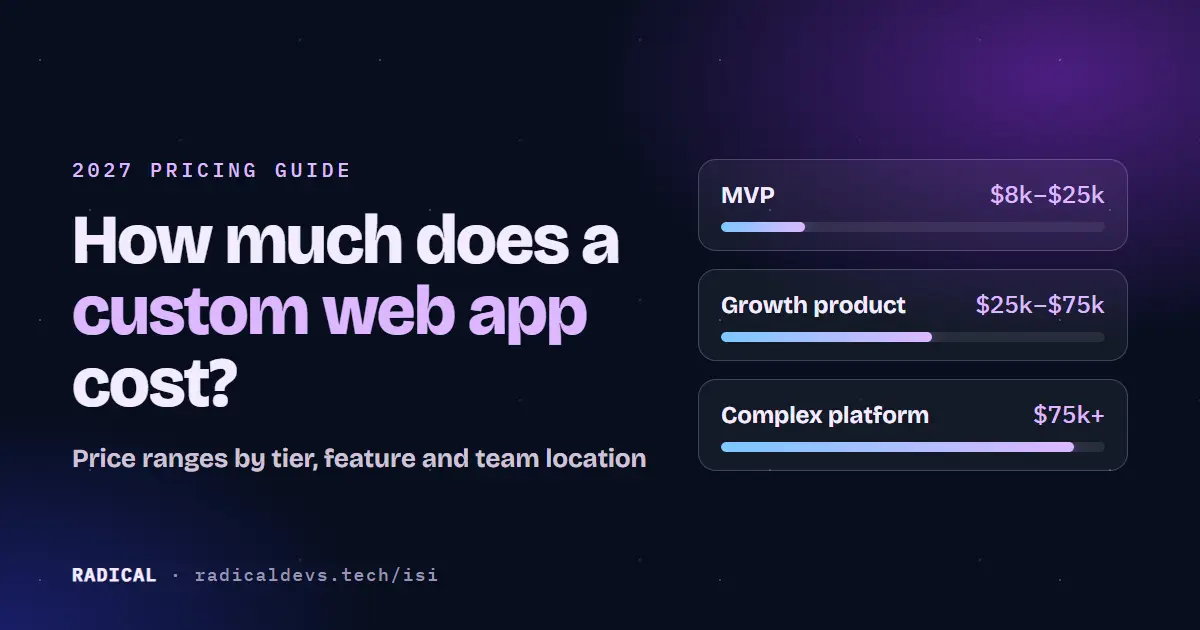
A custom web app usually costs $8,000–$25,000 for an MVP, $25,000–$75,000 for a growth-stage product, and $75,000 or more for a complex platform when a remote agency builds it. The final price depends on three things: how many features you need, how many outside systems the app talks to, and where your development team is based.
The figures in this guide are market estimates for 2027 based on typical remote-agency rates. They are a planning tool, not a quote. If you want a number for your own project, send us your idea and we will reply with a written estimate.
How much does a custom web app cost in 2027?
In 2027 a custom web app costs about $8,000–$25,000 for an MVP, $25,000–$75,000 for a growth-stage product and $75,000 or more for a complex platform. Find the tier that matches your idea, then adjust with the feature table below.
| Tier | What you get | Typical timeline | Estimated cost |
|---|---|---|---|
| MVP | User accounts, 3–5 core screens, admin panel, one payment or API integration, deployment | 6–12 weeks | $8,000–$25,000 |
| Growth product | Roles and permissions, dashboards, several integrations, notifications, analytics, polished design | 3–6 months | $25,000–$75,000 |
| Complex platform | Marketplace or SaaS with multiple user types, real-time features, AI features, high availability | 6–12+ months | $75,000–$250,000+ |
What drives the cost of a web app?
The cost of a web app is the number of development hours multiplied by the team's hourly rate, so anything that adds hours adds cost. Six factors move the number most:
- Number of features and screens. Each feature needs design, backend logic, frontend work and testing.
- Integrations. Payment gateways, CRMs, ERPs, shipping or government APIs each add work, and poorly documented APIs add more.
- User roles. An app where customers, staff and admins see different things needs permission logic on every screen.
- Design depth. A clean design built on a component library costs far less than custom illustration and animation.
- AI features. Chatbots, document search and predictions need data preparation, prompt work and ongoing model costs.
- Team location. The same 400 hours can cost two to four times more depending on where the team is based.
How much do common features cost?
Common web app features cost between about $700 and $17,000 each at remote-agency rates of $35–$70 per hour. Add up the features you need from the table below, then add 15–20% for project management and testing.
| Feature | Typical effort | Estimated cost |
|---|---|---|
| Sign-up, login, password reset, social login | 30–60 hours | $1,000–$4,000 |
| Admin panel to manage users and content | 40–120 hours | $1,500–$8,000 |
| Online payments and invoices (Stripe or similar) | 30–80 hours | $1,000–$6,000 |
| Search with filters and sorting | 30–90 hours | $1,000–$6,000 |
| Each third-party API integration | 20–80 hours | $700–$6,000 |
| Real-time chat or live notifications | 60–150 hours | $2,000–$10,000 |
| Reports and analytics dashboard | 60–160 hours | $2,000–$11,000 |
| Multiple languages, including right-to-left (Arabic, Persian) | 30–80 hours | $1,000–$6,000 |
| AI assistant that answers from your own documents | 80–250 hours | $3,000–$17,000 |
How does team location change the price?
Team location can change the price of the same web app by two to four times: typical agency rates run from about $25–$60 per hour for remote teams in the Middle East and Asia to $100–$200 per hour in the United States and United Kingdom.
| Team location | Typical hourly rate | Cost of a 400-hour MVP |
|---|---|---|
| United States, United Kingdom | $100–$200 | $40,000–$80,000 |
| Western Europe | $70–$150 | $28,000–$60,000 |
| Eastern Europe | $40–$80 | $16,000–$32,000 |
| Remote teams in the Middle East and Asia | $25–$60 | $10,000–$24,000 |
A lower rate only saves money if the team delivers. Before you hire, check their past projects, ask who will write the code, and agree on milestones you can test.
How long does it take to build a web app?
An MVP usually takes 6–12 weeks, a growth-stage product 3–6 months, and a complex platform 6–12 months or more. Timelines slip most when requirements change mid-build or when the client takes weeks to give feedback. A short discovery phase at the start, where scope is written down and agreed, prevents most delays.
Example: what does a $15,000 MVP include?
A $15,000 MVP buys about 370 hours of work at $40 per hour: enough for a booking web app with customer accounts, online payment and an admin panel. Here is the breakdown:
| Work | Hours |
|---|---|
| Discovery, user flows and wireframes | 30 |
| UI design for web and mobile screens | 40 |
| Accounts and authentication | 40 |
| Core booking features | 140 |
| Admin panel (built on Django admin) | 25 |
| Online payment integration | 40 |
| Testing and bug fixing | 35 |
| Server setup, deployment and monitoring | 20 |
| Total | 370 hours ≈ $14,800 |
What ongoing costs should you budget for?
After launch, a web app costs hosting ($20–$100 per month for an MVP), maintenance of about 15–20% of the build cost per year, third-party services and any AI usage. In detail:
- Hosting: $20–$100 per month for an MVP on a cloud server, $200–$1,000+ per month at scale.
- Maintenance: a common rule of thumb is 15–20% of the build cost per year for updates, security patches and small fixes.
- Third-party services: email delivery, SMS, maps and payment fees, usually priced per use.
- AI usage: if your app calls a language model, each request has a cost. Caching and smaller models keep this low.
How can you reduce the cost without cutting quality?
The most reliable way to reduce web app cost is to launch a focused MVP on proven building blocks and pay per milestone. Five practical ways:
- Start with an MVP. Build the one workflow customers will pay for, launch, then add features based on real usage.
- Use proven building blocks. Frameworks like Django give you authentication and an admin panel out of the box, which saves weeks.
- Use a design system instead of designing every component from scratch.
- Add AI in phases. Start with one AI feature that saves time, measure it, then expand.
- Pay per milestone. Fixed-price phases with clear deliverables protect your budget and keep the team accountable.
How does Radical price web app projects?
Radical prices web app projects with a fixed price per phase, agreed after a free scoping call and a written scope. You see working software at every milestone and pay as each one is delivered. Our team builds web apps with Python and Django, mobile apps, and AI features such as chatbots and document search. See our services and past projects, or request your free estimate.
Written by Mohammadjalal Pouromid, AI engineer and data scientist at Radical. Prices are market estimates for 2027 and will vary by scope.
Be the first to share your thoughts.