 Beyond the Vibe Check: Architecting Production-Gr…
Date: July 17, 2026
Beyond the Vibe Check: Architecting Production-Gr…
Date: July 17, 2026

Why Building a Prototype with an LLM is Easy But Building a Production System is Incredibly Hard
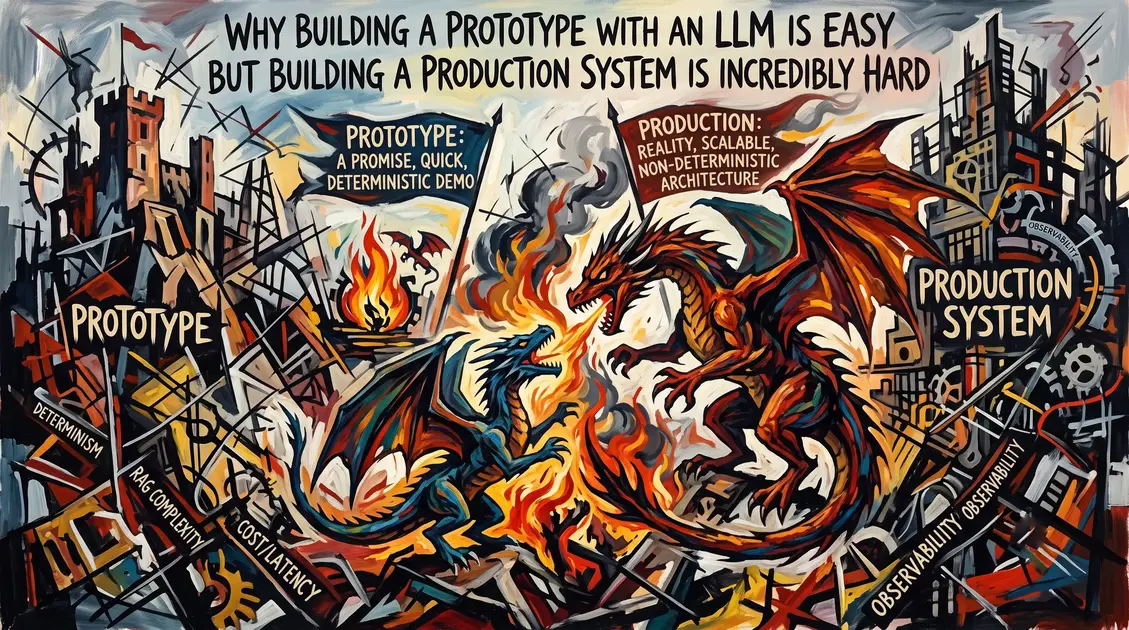
The Illusion of the Weekend AI Project
We have all seen the posts on social media: a developer builds a fully functioning, human-like AI assistant over a single weekend using nothing but twenty lines of Python and a frontier Large Language Model (LLM) API. To the uninitiated, it looks like magic. The prototype responds to queries gracefully, summarizes complex documents in seconds, and seamlessly handles casual conversation. Stakeholders are instantly sold. The budget is approved, and the mandate is clear: take this proof of concept and roll it out to hundreds of thousands of users by next quarter.
Then, the engineering team rolls up their sleeves, and the real work begins. Within weeks, the initial optimism fades as a harsh reality sets in. Building an LLM prototype is deceptively easy because the underlying model does the heavy lifting of understanding natural language. However, building a production-ready LLM system is incredibly hard because it forces engineers to grapple with the unpredictable, non-deterministic nature of foundational models within the rigid, deterministic constraints of enterprise software architecture.
Moving from a prototype to a production system requires shifting your mindset entirely. It is the difference between building a kit car that runs well in a clean garage and manufacturing an enterprise-grade vehicle that can withstand a million miles on unpredictable terrain. Let us break down the core architectural and production realities that make this transition one of the toughest challenges in modern software engineering.
1. The Non-Determinism Dilemma and Reliability
The defining characteristic of traditional software is determinism. If you pass an input of X into a well-written function, you will always get output Y. This predictability forms the foundation of modern software engineering, automated testing, and continuous integration.
LLMs break this fundamental rule. By nature, they are probabilistic engines predicting the next most likely token based on vast distributions of data. In a prototype environment, a prompt tested five or ten times might yield flawless results. But when that same prompt is exposed to thousands of real-world users, the distribution of inputs widens dramatically. Suddenly, the model encounters edge cases, slang, typos, and adversarial prompts that cause its behavior to deviate wildly.
Handling Structural Output and API Fractures
One of the most common ways this manifests is in structural output failures. If your backend architecture relies on the LLM returning a clean JSON object to trigger downstream APIs, a single missing bracket or an unescaped character will break the entire pipeline. While techniques like JSON mode or structured outputs have improved this, they are not foolproof under heavy load or complex schema requirements.
To mitigate this in production, engineering teams must implement robust guardrail architectures. This involves wrapping LLM calls in validation layers that intercept, parse, and clean responses before they hit your core application logic. If the output fails validation, the system must gracefully handle the failure, either by retrying the request with a corrected prompt, falling back to a deterministic heuristic, or alerting the user without crashing the application state.
2. The Deceptive Complexity of Enterprise RAG
Retrieval-Augmented Generation (RAG) is the go-to architecture for grounding LLMs in proprietary business data. In a prototype, RAG feels straightforward: you take a few PDF manuals, split them into chunks, convert them into vector embeddings using an off-the-shelf library, and store them in a local vector database. When a user asks a question, you perform a similarity search and pass the top chunks into the LLM context window.
In production, this naive RAG approach breaks down completely under the weight of enterprise data realities. Enterprise data is massive, messy, and constantly changing. Managing it requires complex data pipelines that can scale effectively.
| RAG Component | Prototype Level (Naive RAG) | Production Level (Enterprise RAG) |
|---|---|---|
| Data Volume & Formats | A few clean PDFs or text files stored locally. | Millions of documents across dynamic formats (PPTX, DOCX, scanned images, SQL databases). |
| Data Governance & Security | All data is accessible to the single testing user. | Strict Row-Level Security (RLS). User A must never see results derived from User B's documents. |
| Chunking Strategy | Fixed-size character splitting (e.g., every 500 characters). | Semantic and parent-child chunking to preserve tables, hierarchies, and cross-references. |
| Retrieval Accuracy | Basic Vector Similarity (Cosine distance). | Hybrid search (BM25 + Vector) combined with cross-encoder reranking layers. |
As outlined in the table, production RAG demands a sophisticated data orchestration strategy. If your data ingestion pipeline fails to account for document versioning, your vector index will serve outdated information. Furthermore, if you do not implement strict metadata filtering aligned with your enterprise access control lists, your LLM will inadvertently leak confidential data to unauthorized users. Solving RAG at scale is eighty percent data engineering and twenty percent AI manipulation.
3. Balancing the Triad: Cost, Latency, and Performance
When you are building a prototype, you rarely look at the bill. Running fifty queries a day against a commercial frontier model costs less than a cup of coffee. Latency is also an afterthought; if a query takes seven seconds to stream a response to your terminal, you patiently wait, impressed by the quality of the generation.
In production, that seven-second delay is an absolute dealbreaker for user retention. High latency kills user experience. Concurrently, if thousands of users run multi-turn conversations every hour, those fractions of a cent per token compound into astronomical monthly API invoices.
Optimizing the Architecture
Production engineering requires optimizing across three competing axes: cost, latency, and accuracy. To pull this off, modern LLM architectures rely heavily on tiered strategies and specialized middleware:
First, teams implement semantic caching layers. If a user asks a question that is semantically identical to a query processed five minutes ago, the system serves the cached response instantly from an in-memory database like Redis, bypassing the LLM API entirely. This drops latency to milliseconds and slashes token costs to zero for repetitive queries.
Second, architectures are shifting away from monolithic model reliance. Instead of sending every simple classification or routing task to a massive, expensive frontier model, production systems use a router model. Simple tasks are triaged to small, fine-tuned open-source models operating on local infrastructure, reserving the expensive commercial models only for highly complex reasoning steps.
4. The Nightmare of Continuous Evaluation and Observability
How do you know your prototype works? You look at it, read the output, and say, \"Looks good to me.\" This manual, anecdotal evaluation is completely fine for a proof of concept. But what happens when you modify a system prompt to fix a bug on page three, and that small wording change inadvertently causes the model to hallucinate or leak internal system instructions on page twenty?
Traditional software relies on unit tests with predictable binaries. You check if an output equals an expected string. With LLMs, the output can be phrased in a thousand different ways and still be correct. Conversely, it can look incredibly polished, confident, and grammatically perfect while being factually entirely wrong.
Implementing LLM Observability
Production systems require automated, continuous evaluation frameworks. This means setting up synthetic testing pipelines that run hundreds of historical user queries against any new prompt or model iteration before deployment. These frameworks leverage advanced metrics like G-Eval, BERTScore, or specialized \"LLM-as-a-judge\" architectures to score generations based on faithfulness, answer relevance, and context recall.
Beyond pre-deployment testing, real-time observability is non-negotiable. Once the system goes live, you need dedicated tracing tools to monitor every single step of your pipeline. When a user reports a bad response, an engineer must be able to trace that specific request back through the API call, view the exact prompt template used, inspect the specific chunks retrieved by the RAG pipeline, and analyze the raw tokens returned by the model. Without this level of transparency, debugging a production LLM application is like shooting in the dark.
Conclusion: Engineering Beyond the Hype
The transition from an LLM prototype to a fully operational production system is where the true value of an engineering team shines. The prototype proves that the technology holds potential, but the production architecture ensures that potential translates into a dependable, secure, and financially viable asset for the enterprise. By respecting non-determinism, treating RAG as a rigorous data engineering discipline, aggressively managing costs and latency, and embedding strict observability into your DevOps pipelines, your team can successfully cross the chasm from an impressive weekend demo to a reliable production reality.
Frequently Asked Questions
Beyond the Vibe Check: Architecting Production-Gr…
Date: July 17, 2026
Share your thoughts with us.