 Why Building a Prototype with an LLM is Easy But …
Date: July 20, 2026
Why Building a Prototype with an LLM is Easy But …
Date: July 20, 2026
 Beyond the Vibe Check: Architecting Production-Gr…
Date: July 17, 2026
Beyond the Vibe Check: Architecting Production-Gr…
Date: July 17, 2026

Architecting Stateful Agentic Workflows: Why LangGraph Outperforms CrewAI in Production
The Production Imperative in LLM Agent Orchestration
Building reliable agentic systems requires moving beyond sequential prompt chains into complex execution loops capable of reasoning, planning, tool execution, and dynamic routing. As engineering teams transition from initial prototypes to user-facing applications, the choice of orchestration framework determines the system's observability, state resilience, and debuggability.
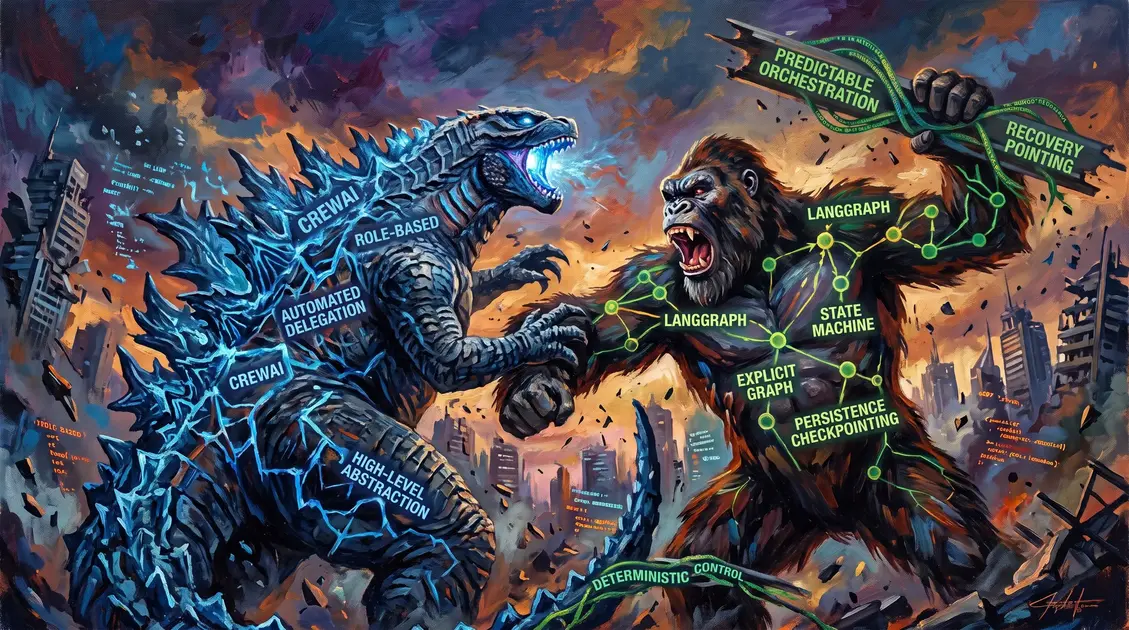
Two prominent open-source paradigms have emerged in the LLM ecosystem: high-level, role-based multi-agent frameworks represented by CrewAI, and low-level, graph-based state machines represented by LangGraph. While CrewAI accelerates early development through pre-packaged agent personas and automated task delegation, LangGraph provides the low-level primitive control required to construct deterministic, stateful systems.
Architectural Foundations: Abstraction vs Control
The core architectural difference between CrewAI and LangGraph lies in how each framework manages execution loops and state representation.
CrewAI: High-Level Role-Based Abstraction
CrewAI abstracts agent logic into structured roles, goals, and tasks. Agents communicate sequentially or hierarchically, with an underlying runtime handling LLM context construction, tool parsing, and task routing. This abstraction simplifies initial implementation by hiding loop mechanics. However, because the execution loop is managed implicitly by the framework, modifying edge cases—such as conditional backtracking or custom routing decisions based on runtime schema outputs—requires overriding internal class behavior or wrapping agent calls in custom orchestration code.
LangGraph: Explicit Graph-Based State Machines
LangGraph models multi-agent systems as explicit directed graphs, inspired by statechart specifications. Nodes represent processing steps (such as calling an LLM, parsing JSON, or invoking an external API), while edges define transition logic. State is explicitly typed and updated through deterministic reducer functions. This design pattern ensures that every state transformation is explicit, observable, and fully controllable programmatically.
Comparative Architectural Matrix
The following table provides a technical evaluation of CrewAI and LangGraph across key engineering vectors:
| Architectural Dimension | CrewAI Framework | LangGraph Framework |
|---|---|---|
| Primary Paradigm | Role-driven multi-agent delegation | Directed state graph (Cyclic/Acyclic) |
| State Management | Implicit task memory and execution history | Explicit, schema-bound centralized state vector |
| Persistence & Recovery | Session-bound memory or local file stores | Built-in checkpointers with time-travel debugging |
| Execution Control | Sequential or hierarchical process loops | Conditional branching, cycles, and custom reducers |
| Human-in-the-Loop | Requires custom wrapper implementation | Native interrupt primitives before and after nodes |
| Failure Isolation | Task-level retry (full chain re-execution risk) | Node-level state recovery and granular re-execution |
Deep Dive: Core Technical Trade-offs
Selecting between these frameworks requires evaluating three fundamental engineering challenges: state persistence, failure recovery, and execution determinism.
1. State Management and Schema Precision
In complex workflows, state must remain structured and predictable throughout multi-turn executions. CrewAI relies heavily on string-based context passing between agents, where outputs from one task serve as inputs to another. Over long reasoning chains, unstructured context leads to context drift, where the agent loses key parameters or key-value constraints.
LangGraph enforces typed state using standard Pydantic or TypedDict schemas. Every node receives the current state dictionary, processes data, and returns an update. Reducer functions dictate how updates merge with existing state (e.g., appending to a list vs overwriting a parameter). This guarantees structural state integrity across arbitrary graph depth.
2. Fault Tolerance and Checkpointing
In production environments, external API outages, rate limits, or context limit violations are common. When a multi-step agent fails mid-execution, re-running the entire workflow incurs significant token cost and latency penalties.
CrewAI lacks built-in transactional state persistence across execution steps out of the box. A failure at step 8 of a 10-step sequence often requires re-executing from step 1 unless specialized error handling is built around the execution engine.
LangGraph implements a native checkpointing architecture. After every node execution, a snapshot of the current state graph is written to a persistent store (such as PostgreSQL, Redis, or SQLite). If an execution fails at step 8, the system can reload the exact state vector from the last valid snapshot and resume processing without repeating completed work.
3. Deterministic Routing vs Autonomous Handoffs
CrewAI relies on LLMs to determine delegation paths dynamically when configured with a hierarchical manager. While powerful for open-ended research tasks, autonomous delegation introduces non-determinism. The manager LLM may route tasks incorrectly or enter infinite delegation loops under novel edge cases.
LangGraph supports both fully autonomous dynamic routing and strictly deterministic conditional edges. Engineers can write Python functions that evaluate specific state conditions—such as checking if an output meets validator criteria or if an API response returned an error code—and deterministically route execution to the appropriate node.
Engineering Verdict: Matching Framework to Requirements
Choosing the correct framework depends directly on system complexity, reliability thresholds, and team velocity needs.
When to Choose CrewAI
CrewAI is highly suited for rapid prototyping, content generation pipelines, and scenarios where open-ended reasoning outweighs deterministic control requirements. If a workflow can be conceptualized as sequential handoffs between defined roles without strict state schemas, CrewAI reduces bootstrap overhead significantly.
When to Choose LangGraph
LangGraph is the preferred architecture for production-grade, stateful, and enterprise-critical agent applications. Applications requiring long-running executions, strict audit logging, precise human approval steps, or complex failure handling benefit directly from LangGraph's explicit state machine primitives.
Frequently Asked Questions
Why Building a Prototype with an LLM is Easy But …
Date: July 20, 2026
Beyond the Vibe Check: Architecting Production-Gr…
Date: July 17, 2026
Share your thoughts with us.