 Architecting Stateful Agentic Workflows: Why Lang…
Date: July 21, 2026
Architecting Stateful Agentic Workflows: Why Lang…
Date: July 21, 2026
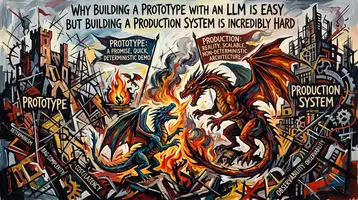 Why Building a Prototype with an LLM is Easy But …
Date: July 20, 2026
Why Building a Prototype with an LLM is Easy But …
Date: July 20, 2026
 Beyond the Vibe Check: Architecting Production-Gr…
Date: July 17, 2026
Beyond the Vibe Check: Architecting Production-Gr…
Date: July 17, 2026

Deep Dive into Context Windows: Why Massive Context Lengths Haven't Killed the Need for Retrieval-Augmented Generation (RAG)

Introduction
The rapid expansion of context window sizes has created the impression that Retrieval-Augmented Generation (RAG) is becoming obsolete. Models capable of processing hundreds of thousands or even millions of tokens appear, at first glance, capable of replacing sophisticated retrieval systems. If an entire knowledge base can fit inside a prompt, why maintain embedding pipelines, vector databases, document chunking strategies, ranking models, and indexing infrastructure?
The answer becomes clear once systems move beyond demonstrations and into production. Context length measures how much information a model can receive during inference. It does not guarantee efficient information retrieval, accurate prioritization, economical execution, fresh knowledge, or maintainable system architecture. These concerns become increasingly important as AI applications scale across enterprise environments.
Modern production systems are gradually converging toward a hybrid architecture where large context windows complement retrieval instead of replacing it. Understanding why requires examining how long-context transformers behave under realistic engineering constraints.
Understanding Context Windows
A context window defines the maximum number of tokens that a transformer model can consider during inference. Every user instruction, retrieved document, system prompt, conversation history, function call, and generated response consumes part of this available budget.
Increasing context size enables several valuable capabilities, including multi-document summarization, extended conversations, codebase reasoning, legal document analysis, and long-form planning. Developers no longer need aggressive prompt compression for many workflows, and applications can preserve significantly more conversational history.
However, larger context windows should not be confused with larger memory. Transformer models perform inference over the supplied context at runtime. They do not permanently acquire the supplied knowledge, nor do they automatically organize it into searchable semantic structures.
Prototype Success Versus Production Reality
A common prototype pattern involves loading an entire documentation set into the prompt and asking questions directly. For small datasets and low request volumes, this often produces impressive results. Unfortunately, production environments expose constraints that prototypes rarely encounter.
Enterprise knowledge bases continuously evolve. Documentation changes daily, customer records update constantly, policies are revised, APIs are versioned, and access permissions differ across users. Sending an entire corpus with every request quickly becomes inefficient, expensive, and operationally difficult.
Attention Allocation Remains a Fundamental Challenge
One misconception surrounding large context windows is that every token receives equal consideration during inference. While transformer architectures attend across the provided context, attention is not uniformly distributed. Position, semantic relevance, prompt structure, competing information, and model-specific optimization strategies all influence which information receives greater focus.
As prompts become significantly longer, useful information competes with irrelevant details. Duplicate passages, outdated documentation, conflicting policies, and repeated explanations increase cognitive load for the model. Although modern architectures mitigate some long-context limitations, larger prompts still increase the probability that important evidence receives less effective attention than carefully selected retrieval results.
Retrieval systems reduce this problem by filtering candidate information before inference begins. Instead of asking the model to identify relevant information from hundreds of thousands of tokens, retrieval narrows the search space to the documents with the highest semantic similarity or ranking score.
Inference Cost Does Not Scale Gracefully
Every token processed during inference contributes to computational cost. Large prompts require more memory, greater computational resources, and longer processing times. Even when model providers support extremely large contexts, using the maximum available window for every request is rarely economical.
The difference becomes significant at production scale. A chatbot serving several internal users may tolerate oversized prompts. A customer-facing assistant processing millions of requests per month cannot.
Retrieval dramatically reduces unnecessary token transmission. Rather than repeatedly sending an organization's complete documentation, only the most relevant sections are injected into the prompt. This minimizes both latency and inference expenditure while preserving answer quality.
Knowledge Freshness Requires External Retrieval
Long context windows do not solve the challenge of dynamic information. Even if an organization successfully includes its entire documentation library inside prompts, that information becomes outdated as soon as content changes.
Enterprise systems require mechanisms for continuously indexing updated knowledge sources. Product documentation, internal wikis, issue trackers, incident reports, compliance policies, customer data, and operational runbooks change frequently. Maintaining prompt templates containing static knowledge quickly becomes operationally unsustainable.
Retrieval-Augmented Generation separates storage from reasoning. Knowledge remains inside databases, search indexes, object storage, or document repositories while retrieval fetches current information immediately before inference. This architecture naturally supports continuous updates without rebuilding prompts or retraining models.
Context Windows Do Not Replace Search
Information retrieval and language reasoning solve different problems. Search systems identify relevant information efficiently. Language models synthesize, explain, compare, summarize, and generate responses using retrieved evidence.
Replacing retrieval with larger prompts effectively asks the language model to perform two separate jobs simultaneously. First, it must locate useful information among enormous quantities of text. Second, it must reason about that information to generate an answer. Separating these responsibilities produces simpler architectures and more predictable behavior.
Architectural Comparison
| Architecture | Advantages | Limitations | Best Use Cases |
|---|---|---|---|
| Large Context Only | Simple implementation, minimal infrastructure, useful for small datasets | High token cost, slower inference, poor scalability, weaker freshness guarantees | Prototypes, demonstrations, static documents |
| Traditional RAG | Lower cost, scalable retrieval, fresh knowledge, efficient prompts | Requires indexing pipeline, chunking strategy, embedding maintenance | Enterprise search, documentation assistants, customer support |
| Hybrid Large Context with RAG | Combines retrieval precision with long-context reasoning, supports complex workflows | Greater architectural complexity and operational monitoring | Production AI systems, coding assistants, research platforms, enterprise copilots |
Retrieval Quality Matters More Than Context Size
Simply retrieving documents is not sufficient. Poor chunking strategies, weak embedding models, inadequate metadata, and ineffective ranking frequently become larger sources of hallucination than model limitations themselves.
Successful RAG systems invest heavily in document preprocessing. Content is segmented according to semantic boundaries instead of arbitrary token counts. Metadata captures ownership, permissions, timestamps, document type, language, and version information. Ranking stages combine vector similarity with keyword search, metadata filtering, and reranking models to improve precision.
The language model ultimately receives cleaner, higher-quality evidence than it would obtain from an indiscriminate collection of raw documents.
Latency Trade-offs
Some engineers assume retrieval always introduces additional latency. While retrieval does add an external search step, extremely large prompts also increase inference time. In many production systems, retrieving a small collection of highly relevant documents is substantially faster than repeatedly processing enormous prompts.
Latency optimization therefore becomes a system-level exercise rather than a model-only optimization problem. Engineers evaluate vector search latency, embedding cache performance, network overhead, model throughput, prompt size, batching efficiency, and response streaming together.
Security and Access Control
Enterprise AI introduces another challenge rarely discussed in benchmark evaluations: authorization.
Different users possess different permissions. Finance teams, engineering teams, legal departments, and executives often access separate knowledge repositories. Injecting all organizational knowledge into every prompt violates fundamental security principles.
Retrieval pipelines naturally enforce document-level permissions before context construction. Search queries return only documents the requesting user is authorized to access. The language model never receives restricted information outside the user's security boundary.
Context windows alone provide no equivalent authorization mechanism.
Operational Maintainability
As AI systems mature, maintainability becomes more valuable than architectural simplicity. Systems based entirely on prompt engineering often accumulate increasingly complex prompt templates containing examples, documentation, business rules, formatting instructions, and exception handling.
Eventually these prompts become difficult to maintain, test, and version.
Retrieval architectures encourage separation of concerns. Search infrastructure manages information discovery. Knowledge repositories remain independent from inference. Prompt templates focus on reasoning instructions rather than embedding organizational knowledge directly. Individual components can evolve independently without rewriting the entire system.
Observability and Debugging
Production AI systems require observability. When incorrect answers appear, engineers need to determine whether failures originated from retrieval, ranking, chunking, embeddings, prompt construction, or model reasoning.
RAG pipelines expose measurable intermediate stages. Teams can inspect retrieved documents, evaluate ranking scores, compare embedding similarity, analyze retrieval recall, and improve indexing strategies. Systems relying solely on massive prompts provide fewer opportunities to isolate failures because all information enters inference simultaneously.
The Future Is Hybrid Architecture
The industry is steadily moving toward architectures that combine increasingly capable language models with increasingly sophisticated retrieval systems. Larger context windows reduce prompt engineering friction and enable richer reasoning across multiple retrieved documents. Retrieval continues to solve efficient information discovery, freshness, authorization, and cost optimization.
Future AI systems will likely retrieve larger evidence sets, preserve more conversational history, reason across broader collections of documents, and support increasingly complex workflows. None of these developments eliminate retrieval. Instead, they increase the value of retrieval by supplying higher-quality evidence for more capable reasoning engines.
Conclusion
Massive context windows represent a meaningful advancement in transformer capabilities, but they are not a replacement for Retrieval-Augmented Generation. Context capacity addresses how much information can be processed during inference. RAG addresses how relevant information is discovered, updated, filtered, secured, and delivered efficiently.
Production AI systems must balance accuracy, latency, cost, maintainability, observability, and security simultaneously. Large context windows improve several dimensions of this problem but do not eliminate the architectural need for retrieval. The most effective systems increasingly combine both approaches, using retrieval to provide precise, current, authorized information and using large context windows to enable richer reasoning over that curated evidence. Rather than choosing between long-context models and RAG, modern AI architecture treats them as complementary technologies that solve fundamentally different engineering problems.
Frequently Asked Questions
Architecting Stateful Agentic Workflows: Why Lang…
Date: July 21, 2026
Why Building a Prototype with an LLM is Easy But …
Date: July 20, 2026
Beyond the Vibe Check: Architecting Production-Gr…
Date: July 17, 2026
Share your thoughts with us.