 Deep Dive into Context Windows: Why Massive Conte…
Date: July 22, 2026
Deep Dive into Context Windows: Why Massive Conte…
Date: July 22, 2026
 Architecting Stateful Agentic Workflows: Why Lang…
Date: July 21, 2026
Architecting Stateful Agentic Workflows: Why Lang…
Date: July 21, 2026
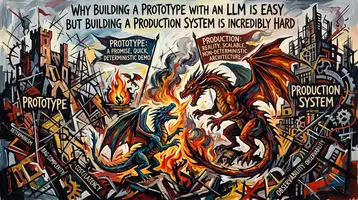 Why Building a Prototype with an LLM is Easy But …
Date: July 20, 2026
Why Building a Prototype with an LLM is Easy But …
Date: July 20, 2026
 Beyond the Vibe Check: Architecting Production-Gr…
Date: July 17, 2026
Beyond the Vibe Check: Architecting Production-Gr…
Date: July 17, 2026

The Costly Mistake of Choosing a Massive LLM When a Fine-Tuned Small Language Model Would Have Sufficed

Introduction
One of the most common architectural mistakes in modern AI systems is assuming that the largest available language model is automatically the best engineering choice. During prototyping, massive foundation models produce impressive demonstrations because they possess broad world knowledge and strong zero-shot capabilities. Unfortunately, those same characteristics frequently become liabilities when an application moves into production.
Production systems optimize for measurable objectives rather than benchmark scores. Response latency, infrastructure utilization, operational cost, reliability, observability, maintainability, and predictable behavior usually matter far more than maximizing reasoning capability for every request. In many enterprise workloads, a fine-tuned Small Language Model (SLM) satisfies functional requirements while significantly reducing complexity.
The question should never be whether a model is large or small. The correct engineering question is whether the selected model satisfies quality objectives with the lowest operational complexity.
Why Bigger Models Become Expensive Architectural Decisions
Large language models require substantial computational resources for inference. Even when inference providers abstract away infrastructure management, engineering teams still pay through increased API costs, slower response times, concurrency limitations, and stricter rate limits.
These issues compound as traffic grows. A prototype serving fifty requests per hour may perform adequately using a frontier model. The identical architecture serving fifty thousand requests per hour experiences dramatically different operational characteristics.
Every additional token generated consumes compute resources. Every increase in latency reduces application responsiveness. Every additional GPU required increases infrastructure expenditure.
Model size therefore becomes an architectural decision rather than simply an AI decision.
Prototype Success Does Not Predict Production Success
Many engineering teams unintentionally optimize for demonstration quality instead of production efficiency. During early experimentation, developers manually evaluate responses and naturally gravitate toward whichever model produces the most sophisticated answers.
Production environments introduce constraints absent from prototypes. Requests become concurrent. Infrastructure experiences load spikes. Customer expectations become measurable service-level objectives. Budget limitations become operational constraints.
The evaluation criteria therefore change significantly. A model that performs marginally better in offline evaluation may produce substantially worse business outcomes if inference costs increase by an order of magnitude or response times exceed acceptable thresholds.
Common Tasks That Rarely Require Massive Models
Many enterprise AI applications solve narrowly defined problems rather than general intelligence tasks. These workloads benefit far more from specialization than model scale.
Examples include document classification, customer support routing, information extraction, structured output generation, entity recognition, contract categorization, product taxonomy mapping, log summarization, SQL generation against known schemas, policy enforcement, code formatting, template completion, and domain-specific question answering.
When the problem space is constrained and representative training data exists, a fine-tuned SLM frequently produces more consistent outputs because its parameters are optimized specifically for that domain instead of attempting to generalize across the entire internet.
Comparing Architectural Strategies
| Architecture | Primary Strength | Primary Weakness | Best Use Case |
|---|---|---|---|
| Large Foundation Model | Excellent zero-shot reasoning across diverse domains | High inference cost and increased latency | Complex reasoning, research assistants, open-domain conversations |
| Fine-Tuned Small Language Model | Fast inference with domain-specific consistency | Limited generalization outside training distribution | Enterprise workflows, classification, extraction, internal assistants |
| SLM with Retrieval-Augmented Generation | Combines specialized reasoning with current knowledge | Requires retrieval infrastructure and indexing pipeline | Documentation search, knowledge bases, support systems |
| Hybrid Routing Architecture | Balances quality and infrastructure efficiency | Additional orchestration complexity | Applications containing both simple and advanced requests |
Latency Is a Product Feature
Engineers often underestimate how strongly users perceive latency. An AI assistant responding in six seconds may appear significantly less reliable than one responding in under one second, even when answer quality differs only slightly.
Inference latency also propagates through distributed systems. Upstream APIs wait longer. Load balancers maintain more active connections. Queue depths increase. Autoscaling reacts more aggressively. Database connections remain occupied longer. End-to-end response time increases beyond the model itself.
Selecting a smaller model frequently improves overall system performance rather than merely accelerating inference.
Infrastructure Complexity Increases Nonlinearly
Model size influences far more than GPU memory requirements. Larger models introduce operational considerations including tensor parallelism, model sharding, quantization strategies, memory fragmentation, batch scheduling, cache optimization, cold-start mitigation, and distributed inference orchestration.
These engineering challenges require specialized expertise that many product teams neither anticipate nor budget for. Operational complexity frequently becomes the hidden cost of choosing a model that exceeds application requirements.
Fine-Tuning Produces Better Domain Alignment
Fine-tuning enables smaller models to internalize domain terminology, output formats, business rules, and organization-specific conventions. Instead of repeatedly encoding instructions inside prompts, knowledge becomes embedded within model parameters.
This approach improves consistency while simultaneously reducing prompt length. Shorter prompts decrease token consumption, improve inference speed, and reduce operating costs.
Fine-tuning is particularly effective when output structure matters more than open-ended creativity. Financial reporting, healthcare documentation, legal document analysis, manufacturing workflows, and compliance automation all benefit from predictable behavior.
The Role of Retrieval-Augmented Generation
Organizations frequently select massive models because they believe broader knowledge is required. In reality, many applications simply require accurate access to organizational information.
Retrieval-Augmented Generation separates knowledge retrieval from language generation. Instead of expecting the model to memorize internal documentation, an external retrieval pipeline supplies relevant context during inference.
This architecture enables smaller models to answer organization-specific questions while maintaining current information without repeated retraining.
The result is often higher factual accuracy, lower hallucination rates, and reduced operational costs compared with relying exclusively on an extremely large model.
Operational Metrics Should Drive Model Selection
Successful engineering organizations evaluate models using production metrics rather than benchmark leaderboards.
Useful evaluation criteria include median latency, p95 latency, throughput under concurrent load, infrastructure utilization, token consumption, cost per request, structured output accuracy, hallucination frequency, recovery from malformed inputs, observability coverage, and operational reliability.
Business metrics should also influence architectural decisions. Customer retention, task completion rate, escalation frequency, and operational savings frequently provide stronger indicators of success than marginal improvements on academic reasoning benchmarks.
When Large Models Are Absolutely Justified
None of this suggests that large language models should be avoided. They remain the correct architectural choice for genuinely difficult reasoning tasks involving complex planning, scientific analysis, advanced software engineering assistance, multi-document synthesis, multilingual reasoning, or highly ambiguous requests.
The mistake occurs when engineering teams deploy frontier models simply because they are available rather than because measurable requirements demand them.
If only five percent of requests require frontier-level reasoning, a routing architecture may send ninety-five percent of traffic to an optimized SLM while escalating only exceptional cases to a larger model.
This hybrid strategy often delivers superior economics without sacrificing user experience.
A Practical Decision Framework
Before selecting any language model, define measurable system objectives. Identify acceptable latency budgets, infrastructure constraints, quality thresholds, regulatory requirements, and expected traffic volume.
Evaluate the smallest candidate capable of satisfying those objectives. If quality remains below acceptable thresholds, progressively evaluate larger alternatives. Escalate model size only when empirical evidence demonstrates meaningful improvements relative to operational cost.
This engineering-first methodology transforms model selection from an intuition-driven decision into a repeatable architectural process grounded in measurable outcomes.
Conclusion
The industry often associates larger models with better systems, yet production engineering consistently demonstrates the opposite. Most successful AI platforms optimize for efficiency, predictability, maintainability, and total cost of ownership rather than maximizing parameter count.
A fine-tuned Small Language Model supported by robust retrieval pipelines, comprehensive evaluation datasets, and thoughtful orchestration frequently delivers better business outcomes than an oversized foundation model deployed indiscriminately.
The objective is not to build the largest AI system possible. The objective is to build the simplest system that reliably satisfies production requirements. That principle has guided software architecture for decades, and it remains equally applicable in the era of language models.
Frequently Asked Questions
Deep Dive into Context Windows: Why Massive Conte…
Date: July 22, 2026
Architecting Stateful Agentic Workflows: Why Lang…
Date: July 21, 2026
Why Building a Prototype with an LLM is Easy But …
Date: July 20, 2026
Beyond the Vibe Check: Architecting Production-Gr…
Date: July 17, 2026
Share your thoughts with us.